Custom software for small businesses: start small.
Your business does not have to be big to have its own software. How 3tf scopes practical CRMs, client portals, booking tools and automation for smaller teams.
The idea in brief
Start with one useful process, define a focused first version and include maintenance in the budget.
Your business does not have to be big
A small company can have its own software without starting with a large, company-wide transformation. The practical route is a focused first version: one useful process, a clear group of users and a defined result.
At 3tf, we create custom software, websites and business automation around the way a company works. That can mean a simple CRM, a client portal, an online booking flow or a dashboard that brings essential information together. The starting point is the task, rather than a long list of features.
Four useful starting points
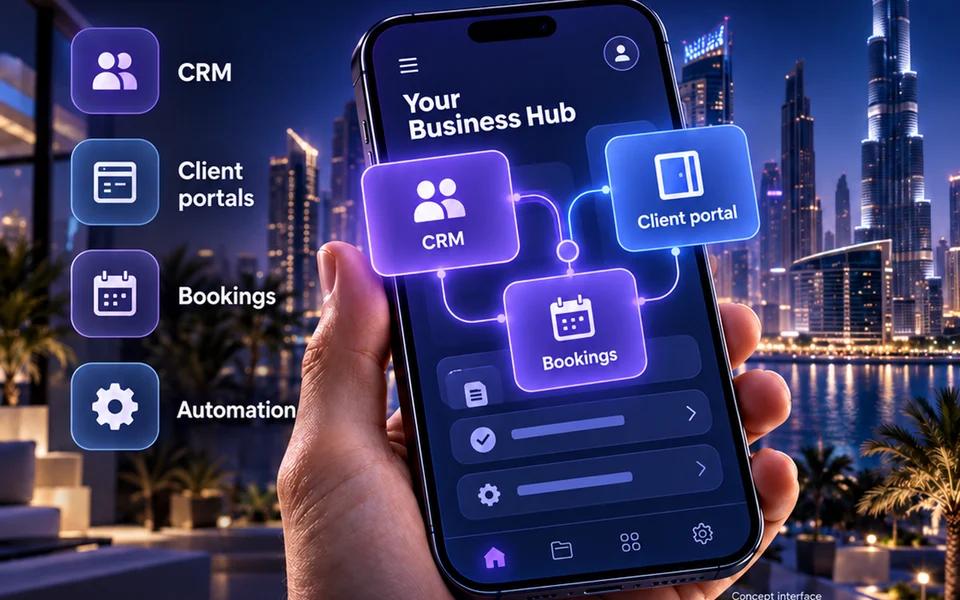
A CRM for your sales process. Keep the stages, client details, tasks and reports that your team actually needs. For example, an enquiry can have a responsible person, a next action and a visible status. The first version does not have to reproduce a complete enterprise platform.
A client portal. Give customers a clear place to find their project status, documents and items waiting for approval. For a service business, this can make responsibilities easier to understand without another chain of messages.
Bookings. Build a service enquiry or booking flow around your schedules and operating rules. Add payment connections or reminders only where they are useful and the required services support them.
A focused dashboard. Bring the information needed for one decision into one view. Define where each number comes from and who is responsible for keeping the underlying records accurate.
Make the scope fit the business
Affordability starts with what you choose to build. A small team rarely needs every possible report, role or integration on day one. Begin with the process that creates repeated administrative work or makes it difficult to see what needs attention.
Write down its current steps. Decide what the first version must do, what can remain manual and what can wait. Test the workflow with the people who will use it before expanding the system.
This is how custom software can become a practical option for a smaller company: a bounded project that solves a useful problem, with a budget matched to the agreed scope. A price should follow those requirements; it should not be guessed from a generic feature list.
Where AI-assisted development fits
We use AI-assisted development to help with repetitive implementation work. Planning, testing, access controls and support still matter. A working demonstration is a starting point for review, not proof that a system is ready to handle every real customer or operational exception.
Custom software also has ongoing costs. Hosting, connected services, maintenance and future changes should be discussed from the beginning. Keeping useful existing tools can be more sensible than replacing everything at once.
Start with one task
Choose one process your team repeats every day. Define a practical outcome, such as fewer duplicate records, clearer responsibility or less time spent preparing the same information. Agree how that outcome will be checked.
Build the first version around that task. Use it, learn from the team and add the next capability when it earns its place.
What is the one task your team should no longer be doing manually?
3tf is a Digital Marketing Agency based in Dubai, UAE. We build custom software, websites and business automation. The visual accompanying this article is a concept interface, not a client result or a finished product demonstration.